
Flowing Wave
Soft, continuous relief. A quiet sculptural surface that changes with the light.
A concept by Emily Popa & Gavin Kress
Red and near-infrared light, reimagined as sculptural art for the spaces we live in.
OurAura brings together a love of art, a background in science, and a belief that wellness technology should be easier to live with and more accessible.
Explore the designs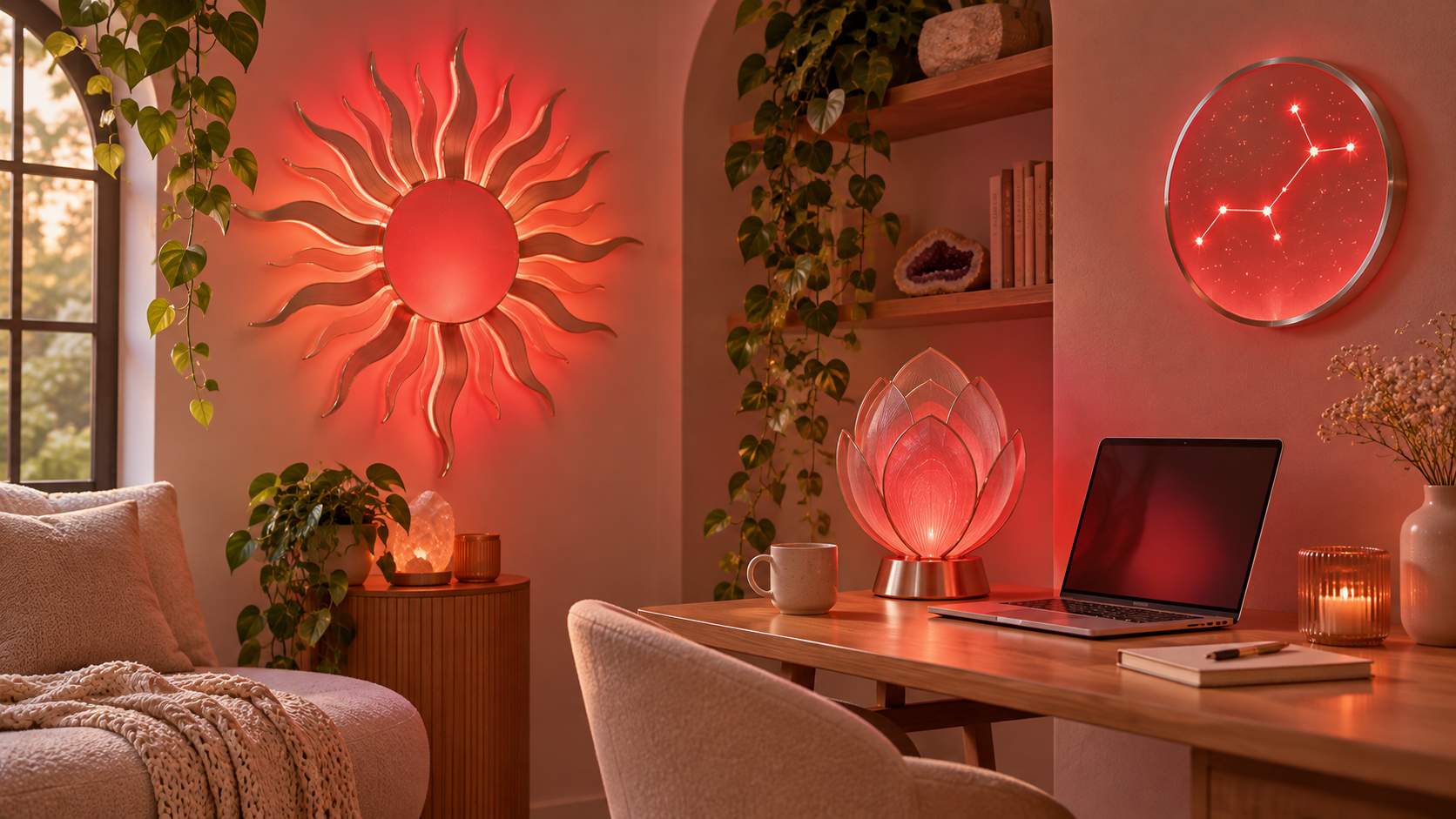
Made for everyday life
OurAura began with a personal red-light setup built around an existing daily routine. Using it became easier to sustain. That experience prompted a new question: could the technology also become something beautiful enough to belong in a room?
The first planned product is a wall-mounted light for dry indoor spaces, with a removable artistic face that also acts as the diffuser.
The core collection
Five artistic directions for a shared rectangular light system. From simple flowing lines and a single halo to celestial shapes and mirrored profiles.
Soft, continuous relief. A quiet sculptural surface that changes with the light.
A single circle on an iridescent surface. Minimal in shape, with a finish that invites a closer look.
Iridescent material studyRadiating lines, shallow relief, and a warm presence on the wall.
A simple crescent with quiet star details, sculpted into a pale opal face.
Two facing profiles, an hourglass between them. Soft, symmetrical waves echo the connection.
Design concepts, shown with the light off and on. Final materials, finishes, and light distribution will be refined through prototyping.
Explore personalizationA personal touch
Choose a monogram, mark a shared date, or create a constellation design around a birthday. Personal details become part of the removable artistic face.
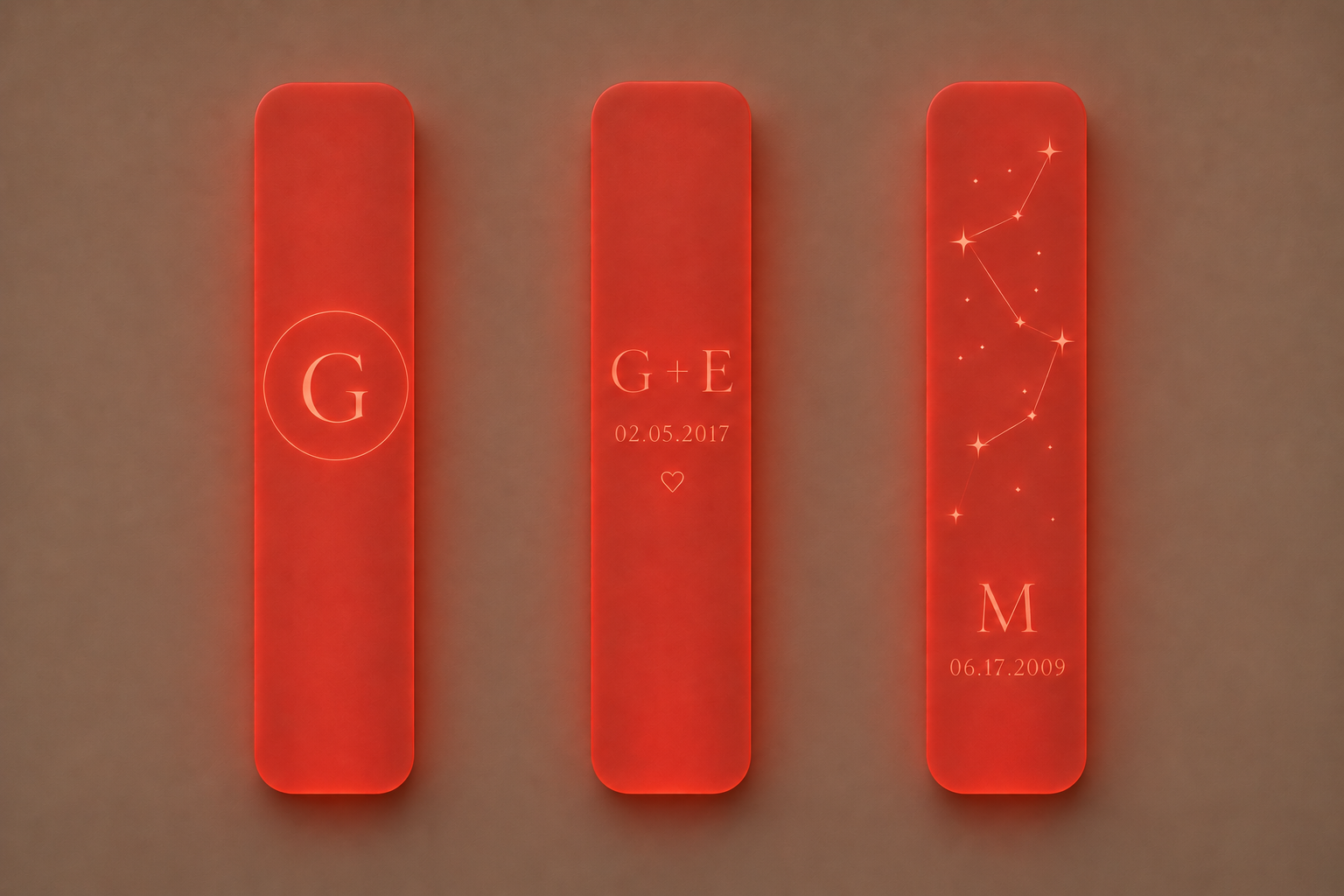
The same modular idea: change the personal artwork while keeping the light base. Personalization options are concepts in development.
A more considered design
The outer artwork would be a removable, translucent diffuser. A new design could give the object a different character while keeping its electronic base in use.
The aim is to let the appearance evolve with a person’s space and preferences, with less need to replace the whole product.
One artistic diffuser attaches to the light base.
Beauty with a purpose
Texture and translucency would shape both the appearance and the light leaving the device. Each artistic face needs to be evaluated as an optical component.
We plan to measure the wavelengths emitted, how much light reaches the intended area at a stated distance, and how evenly it is distributed. Those measurements would guide positioning and session instructions.
Beautiful with the light off, too.
Pale, translucent material is the starting point for the artistic face.
Texture, translucency, character
Flowing ridges, nested profiles, and quiet celestial shapes are different ways to give the same underlying idea a personal character.
We are exploring how shallow relief can be interesting in ambient light and take on a different presence when illuminated. The artistic face remains the diffuser itself.
Illustrative material studies. Transmission, uniformity, and the final finish will be measured and refined using physical prototypes.
The people building OurAura
Scientific research, product design, and hands-on engineering come together in our founding team.
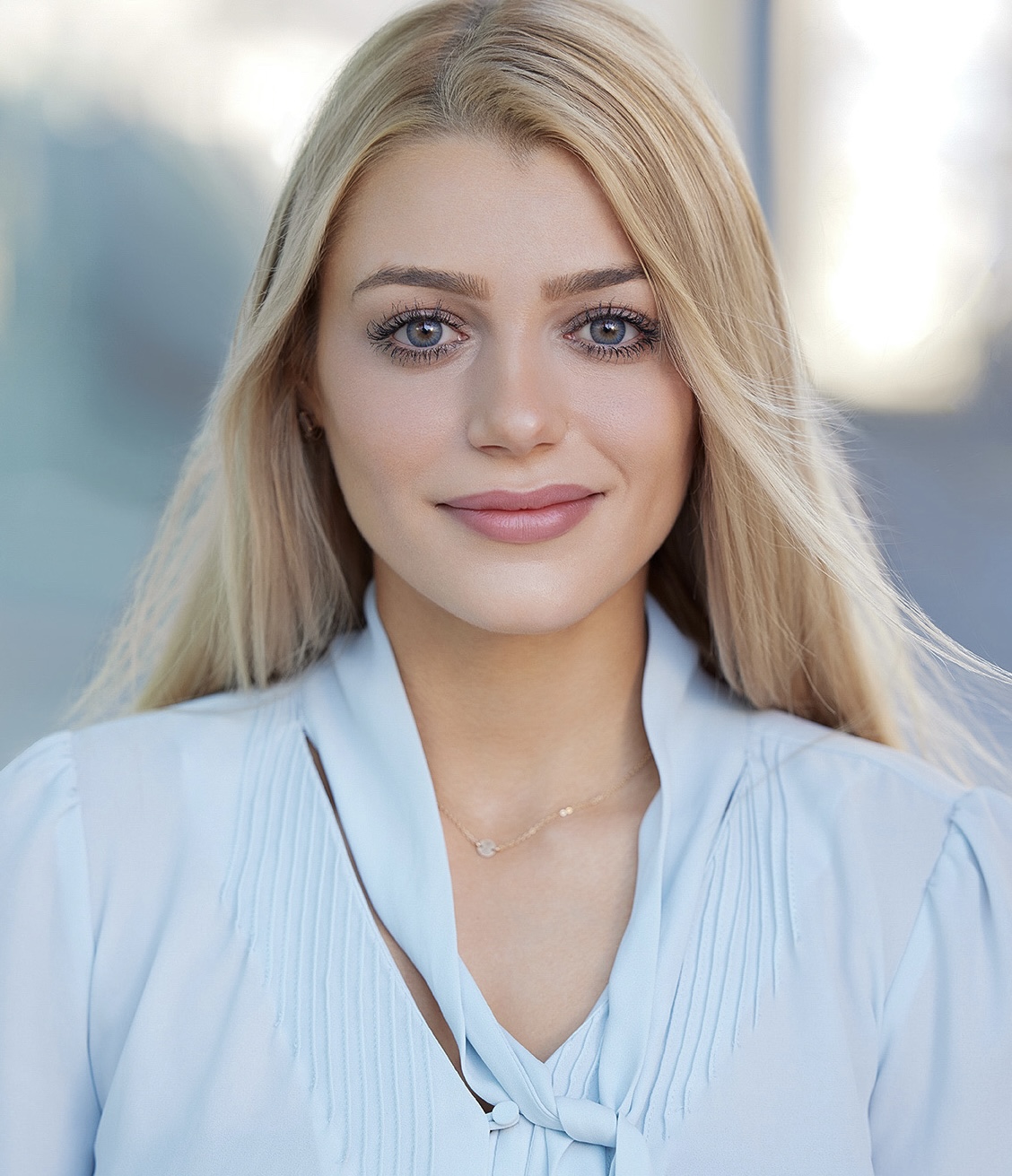
Cofounder · Product vision & design
B.S. in Biopsychology
M.S. in Neuroimaging and Informatics, University of Southern California
Emily leads OurAura’s product vision, artistic direction, customer experience, brand, commercialization strategy, and development of the interchangeable design system.
Her background is in neuroimaging, biomedical research, and scientific technology. She earned her master’s degree at USC and previously worked in the Neuroimaging Core at Pacific Neuroscience Institute for nearly four years, supporting research on Alzheimer’s disease, aging, and neurodegeneration.
That work connected biomedical questions with the practical demands of organizing, processing, and interpreting research data. She brings that same attention to evidence to OurAura’s development: what needs to be measured, what people need to understand, and what the product should be able to deliver.
Emily has also always been drawn to art and the emotional impact of the spaces people live in. OurAura is her way of bringing those interests together, with accessibility and a product people enjoy having in their homes at the center of the idea.

Cofounder · Engineering & technology
B.S. Biomedical Engineering · M.S. Mechanical Engineering, USC
USC Class of 2020 salutatorian · Medical student, Icahn School of Medicine at Mount Sinai
Gavin leads OurAura’s technical development, bringing together biomedical and mechanical engineering, physics, software, and medical training. His work connects the artistic concept with the electronics, optics, thermal design, mounting, and measurements needed to build and evaluate it.
His experience as Chief Technology Officer at NeuroDetect includes leading development of a modular microelectrode-array platform for neurological research. His research background also spans neurovascular work with USC neurosurgery, oncology research and technology at the Lawrence J. Ellison Institute, and computational neuroimaging at Pacific Neuroscience Institute.
Gavin personally leads the technical design and prototype development of an app-controlled implantable photobiomodulation system within a multicenter medical-device research collaboration conducted at Mount Sinai with neurosurgeons and physician-scientists. This work includes the device engineering, prototype fabrication, and companion iPhone app.
That direct experience developing light-based research hardware gives OurAura a practical foundation for prototyping and characterizing its own light system.
From concept to something real
OurAura is pre-revenue. An Amber Grant would support the fabrication and independent testing needed to move the integrated design forward.
Where we are
Initial product architecture, commercially available emitter options, a sculptural diffuser concept, thermal and mounting considerations, and an extensive library of models and designs.
The next milestone
One rectangular base for dry indoor use, beginning with a simple sculptural face. Evaluate fit, mounting, light transmission and distribution, and thermal, electrical, and optical safety before developing additional compatible faces.
Then learn from use
A small usability pilot would examine installation, comfort, and consistent use. Optional app-based check-ins could help document the experience. Reported health changes would be exploratory, not proof of effectiveness.
The business concept includes a simpler Essential version alongside artistic and personalized editions. The aim is to keep the core technology attainable, with prices informed by production costs and customer feedback.
Future concept · Sculptural desktop lights
A sun on a desk. A crescent beside a reading chair. A flower opening toward the room.
Sunburst, Crescent Moon, Mirror Souls, and Bloom explore more personal places for the light. Each pairs a softly sculpted face with a simple stand, bringing the artwork closer without taking over the space.
The immediate focus remains the first indoor wall light. Desktop forms would need their own mechanical, optical, and thermal development.
Future concept · Art that changes with your view
We also want to explore artistic faces whose imagery appears to change as the viewer moves. These sequences show the visual ideas we would investigate through optical prototyping.
Crescent, eclipse, and fuller-disc imagery explored across viewing positions.
Two separate flames, touching tips, and a merged central form.
Stars and connections that appear to shift in depth, with a heart emerging in the pattern.
Proposed viewing effects, not a demonstrated optical mechanism. Each would need to preserve suitable light transmission and distribution as well as produce the intended visual change.
A later direction · Wet-location design
A future shower version would return to the routine that helped inspire OurAura. It would require its own waterproofing, mounting, electrical, thermal, and optical safety development.
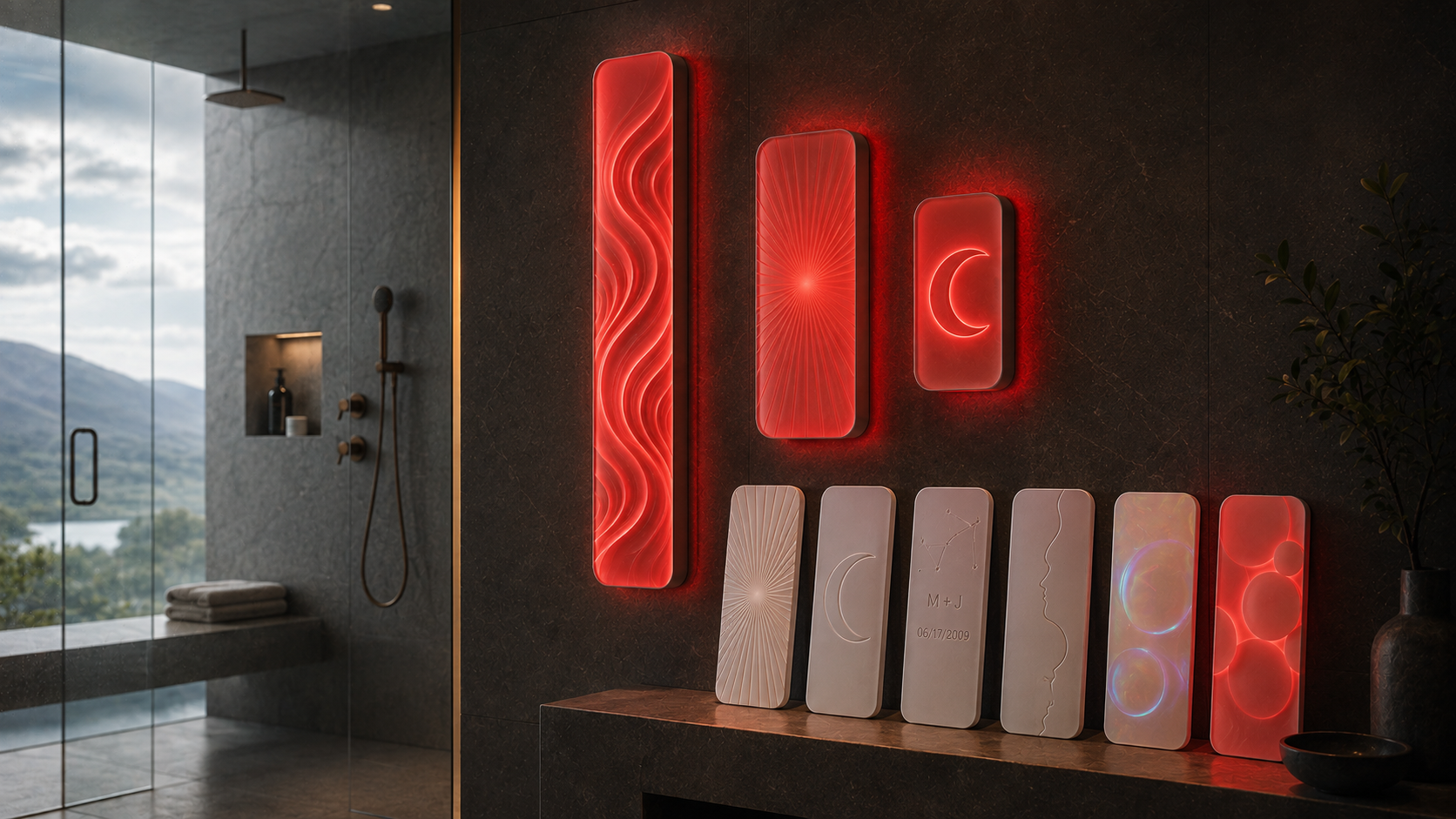
These are concept renderings of proposed designs. The integrated OurAura prototype still needs to be fabricated and tested. Final materials, dimensions, light output, and appearance have not yet been established.
That is the design goal within a selected size and shape. The main collection explores a shared rectangular format. Future desktop and other forms would need their own compatible bases. We will select one base for the first prototype and verify the fit, optical transmission, and light distribution of its compatible faces.
The idea was inspired by a personal setup integrated into a shower routine, but the first OurAura prototype is planned for dry indoor spaces. A wet-location version would need its own engineering and safety assessment.